
Near Canonteign, Devon, 25th September, 1819
Near Canonteign, Devon, 25th September, 1819
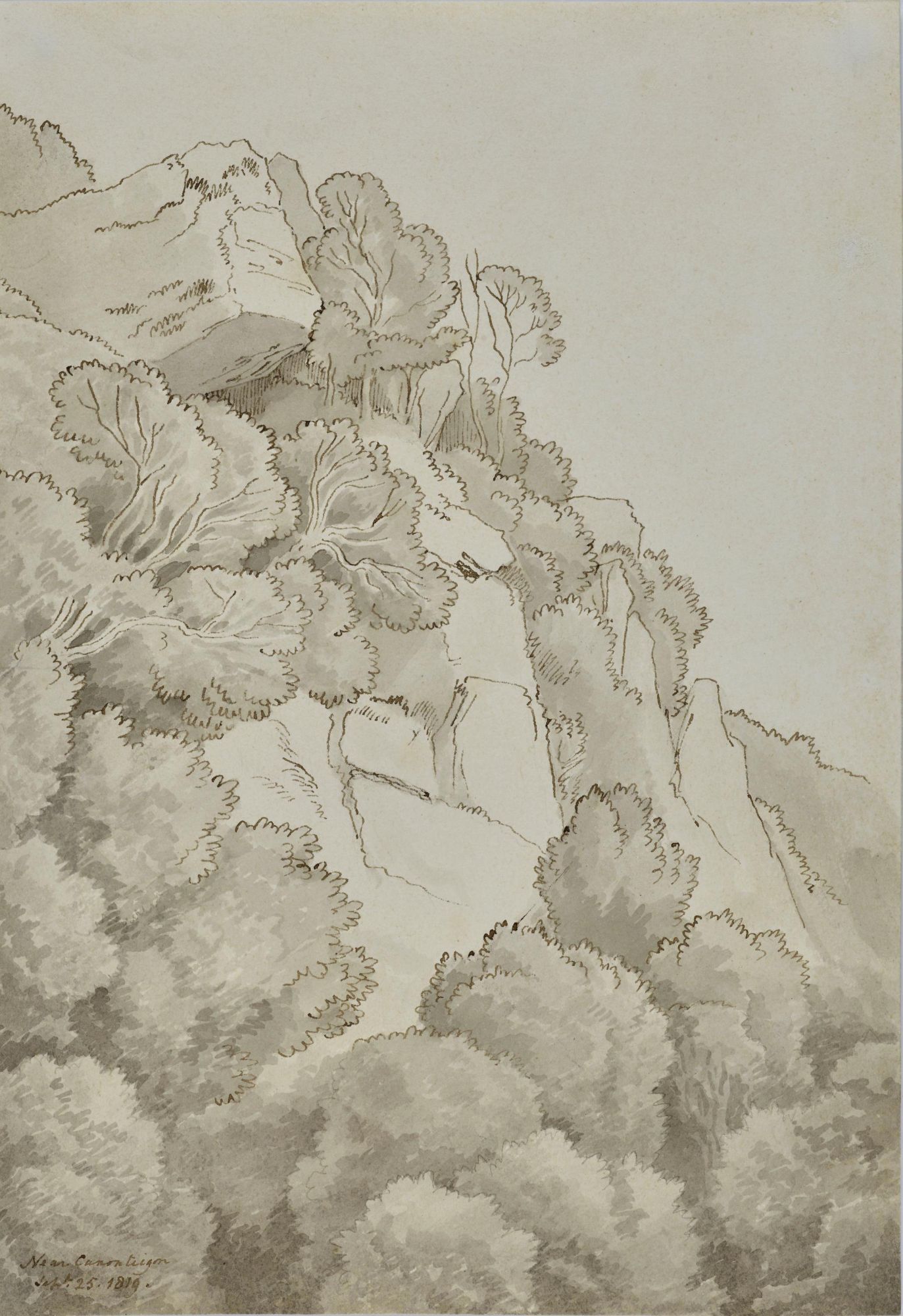
Near Canonteign, Devon, 25th September, 1819Inscribed lower left: Near Canonteign/Sep.t 25 1819.Pen and grey ink and washes over traces of pencil26 by 17.6 cm., 10 ¼ by 7 in.John White Abbott practiced as an apothecary and surgeon in his native Exeter, however, he was also a gifted amateur artist, who is widely regarded as Francis Towne's most accomplished and best-known pupil. He was the nephew of James White, a wealthy Devon lawyer and Towne's executor and on White's death, White Abbott inherited his estate. White Abbott exhibited a series of landscapes in oil at the Royal Academy between 1793 and 1822, as an honorary exhibitor, denoting his amateur status, although his landscapes were regularly praised by critics, with one in particular, remarking in 1794, that they were the best in the exhibition (see Timothy Wilcox, Francis Towne, 1997, p. 158). White Abbott was at the centre of artistic life in Devon, not only through his friendship and pupillage under Francis Town, but he also met and corresponded with John Downman and Ozias Humphrey and through his uncle, met John Merivale and William Jackson. His uncle took the young artist on a visit to London, where he met Sir Joshua Reynolds, Benjamin West and Sir George Beaumont among others. But it was to Francis Towne's style, with careful outline and delicate washes that White Abbott most closely adhered throughout this life. Canonteign lies in South Devon, about 8 miles south-west of Exeter, near Chudleigh, in the valley of the River Teign. It was owned by Edward Pellew, 1st Viscount Exmouth and its dramatic qualities; the steep-sided, rocky formations, with trees and foliage growing out of and clinging to the valley sides, encapsulated many of the most sought-after characteristics of the picturesque and as such was a favourite haunt of both Towne and White Abbott. In nearly all of the latter's depictions of the subject, as is clearly demonstrated in the present drawing, the artist's interest lies in the interplay between the rocks and the myriad plant forms, which he captures with a delicacy of handling and liveliness of line, which marks White Abbott as one of the most accomplished exponents of capturing the natural world.)
John White Abbott (1763-1851)
Near Canonteign, Devon, 25th September, 1819
Inscribed lower left: Near Canonteign/Sep.t 25 1819.
Pen and grey ink and washes over traces of pencil
26 by 17.6 cm., 10 ¼ by 7 in.
John White Abbott practiced as an apothecary and surgeon in his native Exeter, however, he was also a gifted amateur artist, who is widely regarded as Francis Towne's most accomplished and best-known pupil. He was the nephew of James White, a wealthy Devon lawyer and Towne's executor and on White's death, White Abbott inherited his estate.
White Abbott exhibited a series of landscapes in oil at the Royal Academy between 1793 and 1822, as an honorary exhibitor, denoting his amateur status, although his landscapes were regularly praised by critics, with one in particular, remarking in 1794, that they were the best in the exhibition (see Timothy Wilcox, Francis Towne, 1997, p. 158). White Abbott was at the centre of artistic life in Devon, not only through his friendship and pupillage under Francis Town, but he also met and corresponded with John Downman and Ozias Humphrey and through his uncle, met John Merivale and William Jackson. His uncle took the young artist on a visit to London, where he met Sir Joshua Reynolds, Benjamin West and Sir George Beaumont among others. But it was to Francis Towne's style, with careful outline and delicate washes that White Abbott most closely adhered throughout this life.
Canonteign lies in South Devon, about 8 miles south-west of Exeter, near Chudleigh, in the valley of the River Teign. It was owned by Edward Pellew, 1st Viscount Exmouth and its dramatic qualities; the steep-sided, rocky formations, with trees and foliage growing out of and clinging to the valley sides, encapsulated many of the most sought-after characteristics of the picturesque and as such was a favourite haunt of both Towne and White Abbott. In nearly all of the latter's depictions of the subject, as is clearly demonstrated in the present drawing, the artist's interest lies in the interplay between the rocks and the myriad plant forms, which he captures with a delicacy of handling and liveliness of line, which marks White Abbott as one of the most accomplished exponents of capturing the natural world.