
Crossing Lancaster Sands
Crossing Lancaster Sands
Crossing Lancaster SandsSigned, lower left: David CoxWatercolour over pencil 26 by 37.9 cm., 10 ¼ by 14 ¾ in.Provenance: Private collection, OxfordshireThe dramatic sand crossing of the Lancaster Sands at the head of Morecambe Bay inspired many artists. However, the two most closely associated with the subject are J.M.W. Turner (1775-1851), who crossed the sands in 1816 and David Cox. Cox first visited Lancaster in July 1834 and returned both the following year and in 1840. Between 1835 and 1847, he produced a number of watercolours and oils inspired by the vast coastal stretch. In the present watercolour the artist has chosen to depict cattle being driven across the sands in groups, into the setting sun, which must have been a perilous undertaking, even in clear, calm weather. The vast expanse of sands that stretch across the head of Morecambe Bay and are referred to as both Lancaster Sands and Ulverston Sands, as Lancaster lies on the Eastern shore and Ulverston to the West. It is the largest intertidal area in the UK, where twice a day, the ebbing tide exposes 120 square miles of mudflats and sand, which is completely covered at high tide. Although used regularly on foot, mounted and by coach from the Middle Ages and as can be seen in the present watercolour, marked out by 'brobs', laurel branches stuck into the sand, it is a highly risky journey, with shifting channels, areas of quicksand and racing tides, that can easily cut off unwary travellers. Travel was only undertaken with the help of a guide, to help the traveller across the most dangerous parts of the sand. The route is no longer used routinely, although there are guided walks. However, as Thomas Pennant noted in 1772, when travelling from Chester to Scotland that when the weather was bad, or the tide was on the turn, the experience was very different: 'A melancholy ride of eleven miles; the prospect on all sides quite savage, high barren hills indented by the sea, or dreary wet sands, rendered more horrible by the approach of night.' (Thomas Pennant, A tour in Scotland, and voyage to the Hebrides, 1772, p.25).)
David Cox (1782-1859)
Crossing Lancaster Sands
Signed, lower left: David Cox
Watercolour over pencil
26 by 37.9 cm., 10 ¼ by 14 ¾ in.
Provenance:
Private collection, Oxfordshire
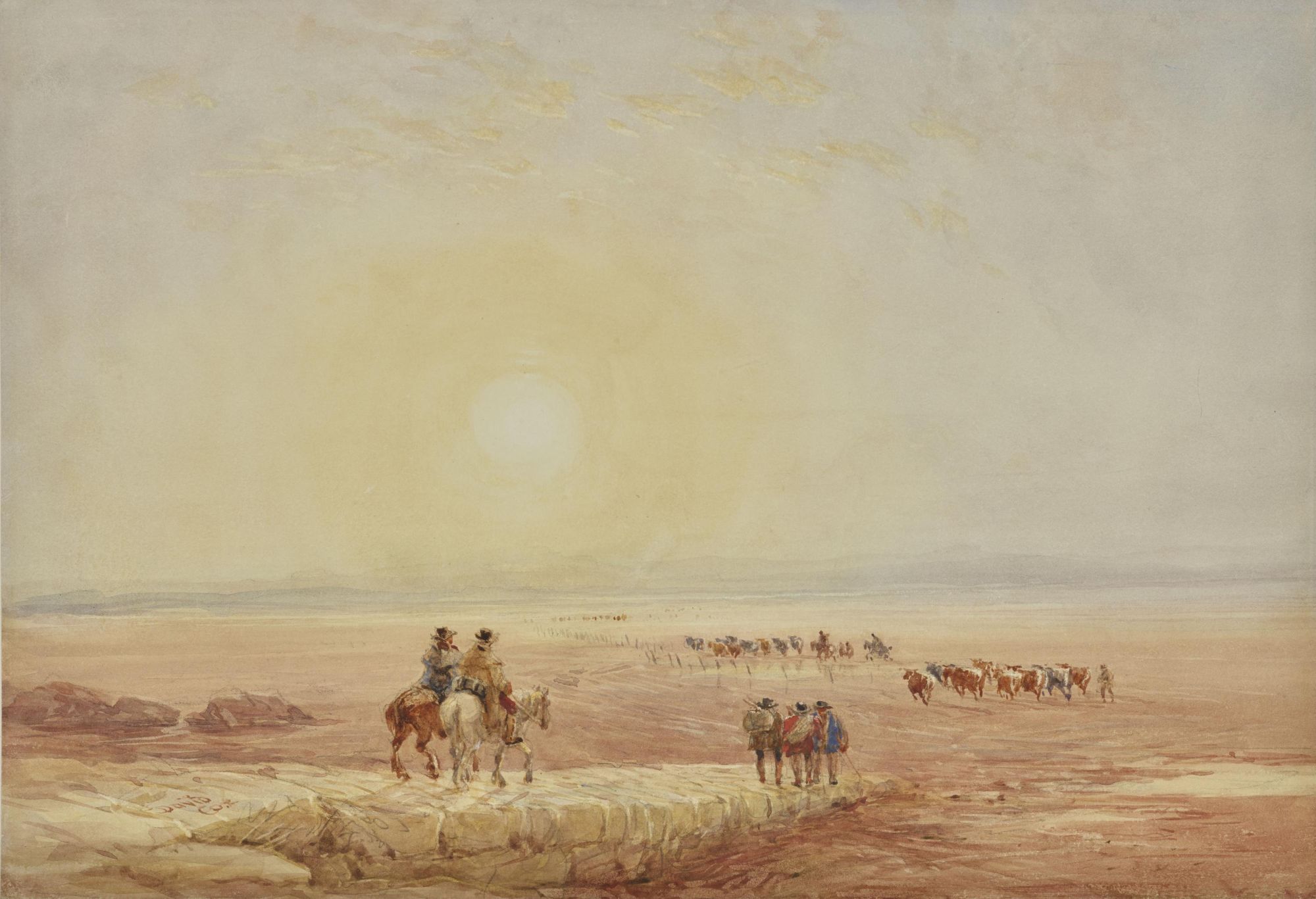
The dramatic sand crossing of the Lancaster Sands at the head of Morecambe Bay inspired many artists. However, the two most closely associated with the subject are J.M.W. Turner (1775-1851), who crossed the sands in 1816 and David Cox. Cox first visited Lancaster in July 1834 and returned both the following year and in 1840. Between 1835 and 1847, he produced a number of watercolours and oils inspired by the vast coastal stretch. In the present watercolour the artist has chosen to depict cattle being driven across the sands in groups, into the setting sun, which must have been a perilous undertaking, even in clear, calm weather.
The vast expanse of sands that stretch across the head of Morecambe Bay and are referred to as both Lancaster Sands and Ulverston Sands, as Lancaster lies on the Eastern shore and Ulverston to the West. It is the largest intertidal area in the UK, where twice a day, the ebbing tide exposes 120 square miles of mudflats and sand, which is completely covered at high tide. Although used regularly on foot, mounted and by coach from the Middle Ages and as can be seen in the present watercolour, marked out by 'brobs', laurel branches stuck into the sand, it is a highly risky journey, with shifting channels, areas of quicksand and racing tides, that can easily cut off unwary travellers. Travel was only undertaken with the help of a guide, to help the traveller across the most dangerous parts of the sand. The route is no longer used routinely, although there are guided walks. However, as Thomas Pennant noted in 1772, when travelling from Chester to Scotland that when the weather was bad, or the tide was on the turn, the experience was very different: 'A melancholy ride of eleven miles; the prospect on all sides quite savage, high barren hills indented by the sea, or dreary wet sands, rendered more horrible by the approach of night.' (Thomas Pennant, A tour in Scotland, and voyage to the Hebrides, 1772, p.25).